Business
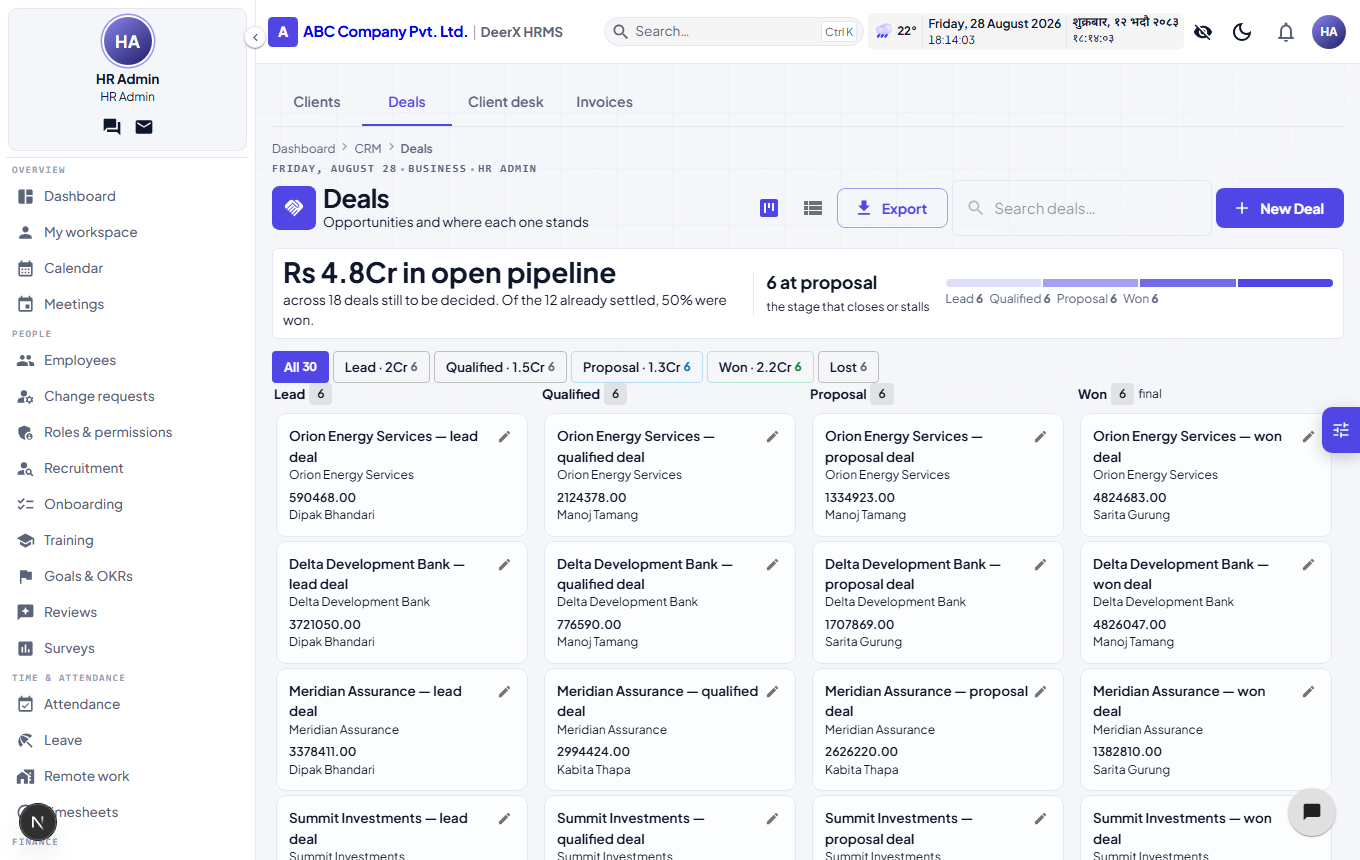
Clients, deals and invoices, for the companies that also sell.
A services company runs HR in one system and its client work in a spreadsheet, and nobody can say which project the person they just hired is billable to.
01
Clients, deals, projects and invoices share the workspace with the people who do the work, so a project has real employees on it rather than names.
02
The client desk is its own queue, separate from the internal helpdesk — a customer's complaint must never surface in the IT queue, and the privacy rules genuinely differ.
03
Invoices total from their line items in the database, so a list can be sorted and summed by what is owed rather than by what somebody typed into a summary field.
What is in Business
CRM
Clients, contacts, deals, projects and tasks.
Invoicing
Line-itemised client invoices out of the same projects.
Reports
Team, attendance, leave, payroll and WFH as JSON or XLSX.
Import & export
Bulk employee import and data export across modules.
Operator console
Cross-tenant analytics, provisioning, accounting, audit log.
What it does not do
Stated on purpose. A page that claims everything tells you nothing.
No payment gateway. An invoice records what is owed; collecting it is your bank's job.
This is not a full CRM. It covers the client work a services company already does beside its HR, and stops there.
Keep reading